
.jpg)
8 Best Staffing Software Options for Catering Companies and Caterers
Key Takeaways
- Catering operations require flexible scheduling platforms capable of handling fluctuating event schedules, diverse venue rules, and variable labor budgets.
- Standard office-based scheduling software fails for caterers because it cannot handle pop-up venue logistics, variable pay rates, or rapid off-site check-ins.
- Essential evaluation criteria include mobile shift dispatching, automated compliance rules, real-time geofenced clock-ins, and multi-venue tracking.
- Deploying platforms like Ubeya connects catering staff management directly with flexible temp pools, automated payroll processing, and instant worker messaging.
Coordinating catering staff management across weddings, corporate galas, and multi-day outdoor festivals presents constant operational challenges. Because every catering event features unique client requirements, distinct venue layouts, and unpredictable guest counts, managing staff schedules using static spreadsheets or manual texting threads leads to severe labor overruns, missed shifts, and event day chaos.
Adopting specialized catering staffing software gives catering directors and event coordinators the digital tools needed to automate shift dispatches, enforce skill requirements, and track labor costs across off-site locations while keeping guest service standards high.
Why Catering Staffing Is More Complex Than Standard Shift Scheduling
Managing catering crews involves distinct operational pressures that differ significantly from static retail or restaurant operations:
- One-Off Event Logistics: Catering teams operate across constantly changing physical environments, from outdoor farms to historic mansions. Each venue requires specific call times, entry directions, parking guidelines, and uniform standards.
- Multi-Tier Skill and Certification Requirements: A single catering event requires specialized roles—including head chefs, banquet captains, certified mixologists, passed-appetizer servers, and scullery crews—each with distinct pay rates and mandatory certifications.
- Extreme Time Compression and Last-Minute Changes: Client guest counts fluctuate up until the event date. Catering managers must scale headcount up or down rapidly and handle last-minute call-outs within hours of service.
- Mixed Labor Pools: Catering companies regularly rely on a combination of core full-time staff, flexible part-time crews, and third-party temporary agency workers to cover peak weekend event surges.
What to Look for in Catering Staffing Software Before You Buy
Selecting the right catering scheduling software requires evaluating capabilities built specifically for dynamic event environments:
- Mobile-First Shift Dispatch and Bidding: Deskless catering staff need a native mobile app to receive shift invites, view venue arrival briefs, confirm availability, and claim open shifts instantly.
- Geofenced GPS Time Tracking: Off-site catering events lack physical punch clocks. The software must enforce GPS geofencing around venue perimeters, allowing staff to clock in strictly when on site.
- Skill and Credential Verification: Hardcoded scheduling rules must verify that workers possess required food safety certifications, mixology licenses, and role experience before allowing them to accept specialized shifts.
- Automated Payroll and Billing Preparation: The system should automatically match verified clock-in timestamps against client-specific bill rates and position pay rates, streamlining catering payroll calculations.
- Integrated Communication Tools: The platform needs built-in push notifications and group chat channels to broadcast venue updates, dress codes, and run-of-show adjustments directly to assigned teams.
8 Best Catering Staffing Software Options for Caterers
To help catering executives select the right platform, we evaluated the eight best software solutions designed for catering companies, banquet directors, and event food service teams.
1. Ubeya
- Best For: Catering companies, banquet venues, event staffing agencies, and food service groups managing high-volume, multi-venue, and flexible labor pools.
Ubeya is an all-in-one workforce management platform engineered specifically for the fast-moving realities of event-based and shift-based operations. Rather than treating scheduling as an isolated administrative task, Ubeya unifies candidate sourcing, smart mobile dispatch, real-time time tracking, and catering payroll preparation into a single operational hub.
The software excels at coordinating hybrid talent pools, enabling catering directors to schedule internal core staff alongside external temporary agency workers within a single master dashboard. Event leads broadcast open shifts directly to qualified worker groups via a native mobile app. Staff receive venue briefs, confirm shift availability, and clock in via geofenced GPS verification. Ubeya automatically enforces certification rules, tracks overtime thresholds, and reconciles event pay rates, eliminating manual errors and protecting margins.
Calculating precise team requirements using our guide on how many catering staff do I need allows catering managers to input optimal headcount ratios directly into Ubeya's automated scheduling engine.
2. 7shifts
7shifts is a popular team management platform built specifically for the food and beverage industry. It offers drag-and-drop scheduling, mobile messaging, sales-driven labor forecasting, and manager logbooks. Catering operators running stationary kitchen operations benefit from its POS integrations and break compliance tracking, though managing off-site pop-up venues and third-party agency pools requires broader agency features.
3. Deputy
Deputy provides flexible employee scheduling and time tracking tools designed for retail, hospitality, and service businesses. It features intuitive mobile rosters, auto-scheduling algorithms, facial-recognition kiosk clock-ins, and meal break compliance tracking. Deputy excels at static venue scheduling, though caterers managing complex off-site event logistics may find its event-briefing capabilities somewhat basic.
4. Connecteam
Connecteam offers an accessible deskless employee app that combines shift scheduling, team messaging, digital checklists, and training modules. Catering leads can create custom shift channels, share event briefing packets, attach venue maps, and track GPS time clock entries. It serves as a strong all-in-one mobile solution for boutique caterers, though larger operations seeking automated demand-driven labor modeling might require enterprise software.
5. Caterease
Caterease is a comprehensive catering and event management software system focused on event sales, banquet event orders (BEOs), menu planning, and client invoicing. While its primary strength lies in front-office event planning, it includes staff scheduling modules that tie crew requirements directly to booked BEOs. It is an excellent choice for full-service event caterers wanting sales-to-staffing integration.
6. Planday
Planday, owned by Xero, is a cloud-based workforce management platform designed for mid-sized hospitality and venue operations. It enables catering managers to build rosters that account for employee availability, contracted hours, and labor budgets. Its built-in communication hub allows managers to broadcast updates to specific event teams, though configuring complex multi-venue shift patterns requires initial onboarding support.
7. Staffy
Staffy is a specialized on-demand staffing marketplace and scheduling platform built to connect hospitality and catering operations with pre-vetted, skilled event talent. It allows catering companies to fill sudden shift vacancies with certified servers, line cooks, and bartenders on short notice. While highly effective for emergency shift fulfillment, it functions primarily as a talent clearinghouse rather than a full internal workforce management suite.
8. Total Party Planner
Total Party Planner is an all-in-one catering management software designed to streamline catering operations, menu engineering, client invoicing, and staff scheduling. It automatically translates booked event menus into required kitchen prep and service labor hours, helping caterers maintain accurate food and labor cost controls. It suits small-to-midsize caterers seeking unified back-office software.
Software Comparison Across Key Features
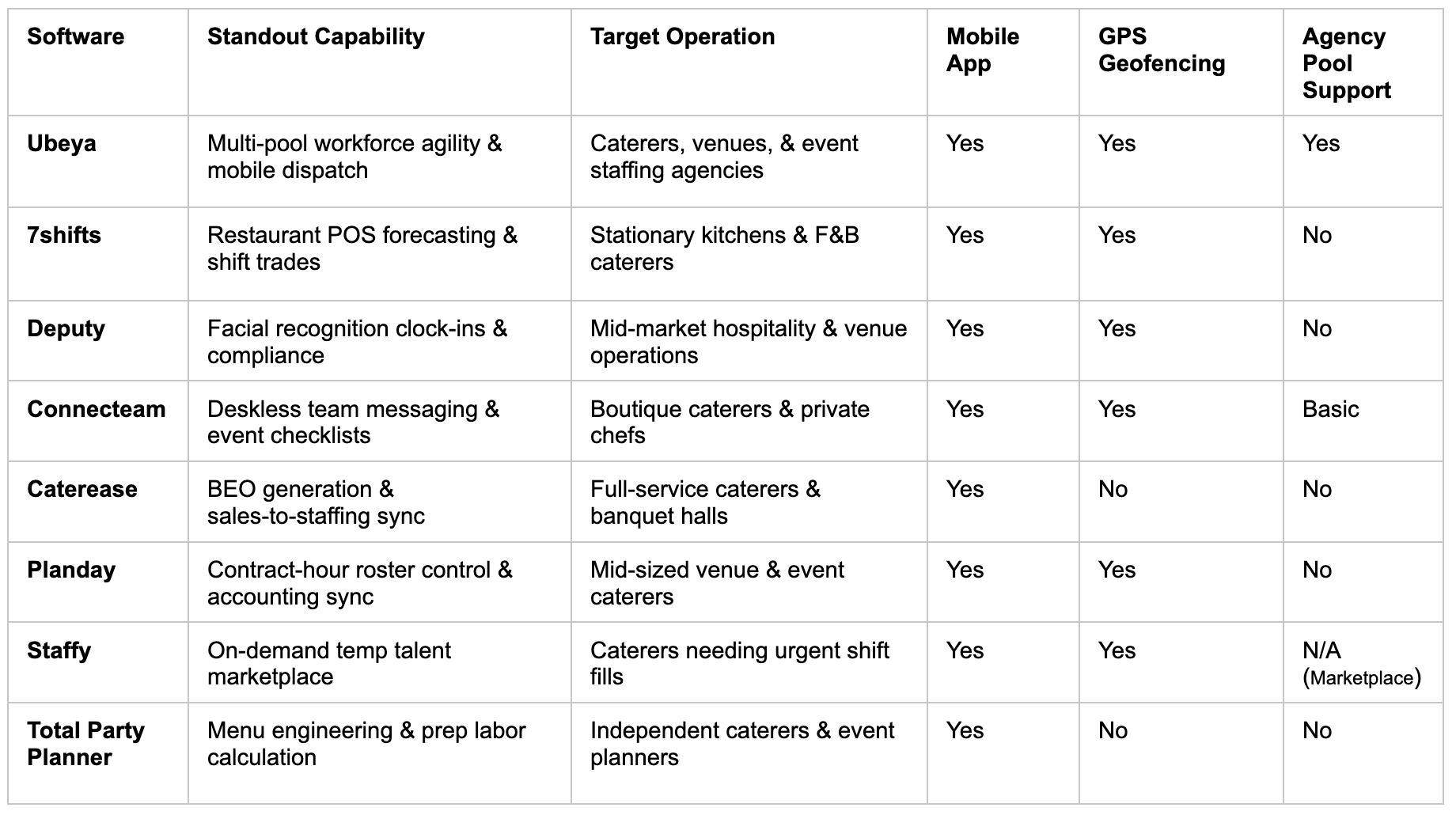
How to Match the Right Platform to Your Event Volume and Crew Size
Selecting the right platform requires aligning software capabilities with your specific operational scale and catering model:
Boutique Caterers and Private Chefs
Catering operations executing two to five events per week with small teams should prioritize ease of deployment, mobile app adoption, and digital event briefing. Look for platforms that allow managers to send venue location maps, uniform requirements, and run-of-show schedules directly to staff smartphones via SMS verification.
High-Volume Event Caterers and Banquet Venues
Large catering companies managing dozens of concurrent off-site events per weekend require automated skill matching, geofenced GPS time tracking, and multi-tier agency vendor management. Your platform must handle multi-rate payroll calculations and block uncertified or over-scheduled staff automatically. Combining these operational tools with AI workforce management high-volume food service strategies ensures catering teams maintain tight labor cost controls as event volume scales.
How to Roll Out Catering Staffing Software Without Disrupting Event Season
Introducing new software during peak catering season requires a structured, phased deployment roadmap:
- Audit Role Certifications and Pay Rates First: Map out all job classifications (e.g., banquet captains, bartenders, scullery) alongside their required certifications, client bill rates, and worker pay rates before configuring system templates.
- Onboard Staff via Frictionless Mobile Links: Send mobile app download links directly to staff smartphones using simple SMS magic links, eliminating password barriers and ensuring quick setup before major event weekends.
- Standardize Digital Event Briefing Packets: Build reusable event templates that automatically attach venue access rules, parking directions, and dress codes to every shift dispatch notification.
- Pilot on Small Events First: Run the new platform on mid-week corporate drop-off catering orders or smaller private events before deploying it across massive weekend wedding operations.
FAQs
Can catering staffing software handle last-minute event changes?
Yes. Modern platforms allow catering managers to update shift details, call times, or headcount requirements instantly. When changes occur, the system sends automated push notifications to assigned staff smartphones, requiring workers to tap to re-confirm their updated shift details in real time.
Does catering staffing software support temp and gig workers?
Yes. Platforms like Ubeya allow caterers to manage core employees alongside temporary agency workers and independent gig staff within a single master interface. The software automatically applies distinct bill rates, tax classifications, and scheduling priorities to each worker group.
Can one platform manage staff across multiple catering venues?
Yes. Cloud-based catering software allows operators to schedule, track, and dispatch crews across unlimited off-site venue locations simultaneously. Managers gain a live overview of attendance and labor costs across every active event site from a centralized dashboard.
How does GPS clock-in work for off-site catering events?
GPS clock-in utilizes the worker’s smartphone location data. Managers set up a virtual geofence around the event venue address. When crew members arrive on site, the mobile app verifies their physical presence inside the designated perimeter before permitting them to clock in for their shift.
Does catering staffing software integrate with catering management tools?
Yes. Leading workforce platforms feature open APIs and pre-built integrations that connect directly with catering management systems (such as Caterease or Total Party Planner). This allows approved Banquet Event Orders (BEOs) and menu plans to generate required staff rosters automatically.
.jpg)

