
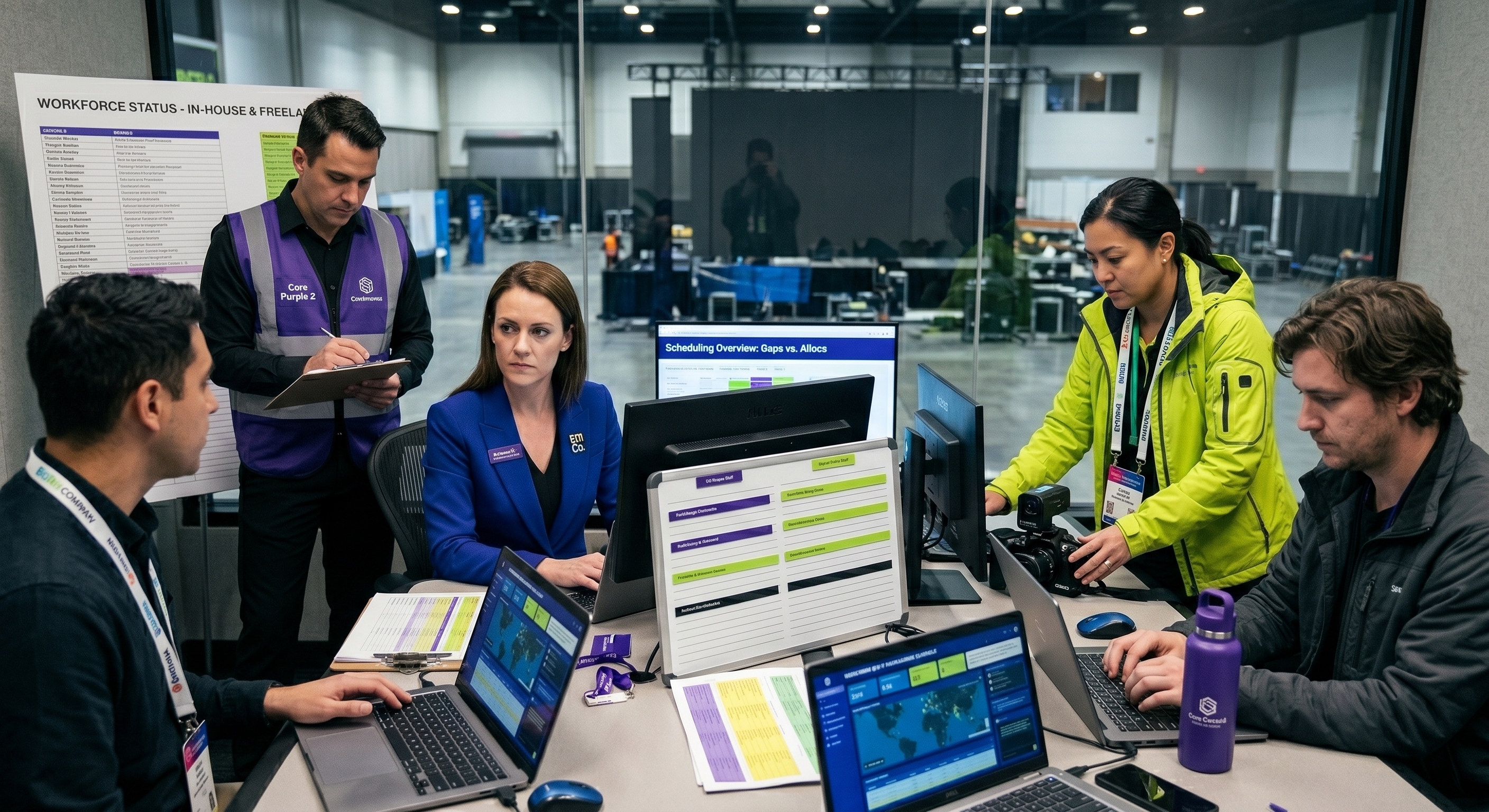
Strategic Workforce Planning for Event Management: In-House vs Freelance Models
Key Takeaways
- Strategic workforce planning helps event businesses balance cost, flexibility, and operational efficiency.
- Choosing between in-house and freelance staff depends on event scale, frequency, and required expertise.
- Modern workforce platforms allow teams to manage both models seamlessly within a single system.
What Is Strategic Workforce Planning in Event Management?
Strategic workforce planning in event management refers to the process of aligning staffing resources with operational goals across events of varying size and complexity. It involves forecasting staffing needs, identifying skill requirements, and ensuring the right people are in the right roles at the right time.
Unlike simple scheduling, this approach takes a long term view. Event organizers must consider seasonal demand, recurring contracts, and fluctuating attendee volumes. For example, a stadium hosting weekly matches will plan differently from a company managing occasional large scale conferences.
At its core, strategic workforce planning connects staffing decisions to broader business outcomes. It impacts cost control, service quality, and team performance. When done well, it enables smoother operations and reduces last minute staffing issues.
Many event organizations now rely on digital tools to support this process. Platforms designed for event workforce management help centralize staff data, track performance, and streamline workforce allocation across multiple events. This creates a more agile and responsive staffing strategy that can adapt to changing demands.
For a deeper understanding of how planning frameworks evolve in dynamic environments, many teams explore approaches similar to those outlined in broader workforce planning strategies.
In-House vs Freelance Workforce Models in Event Management
Event businesses typically operate using one of two primary staffing models, or a hybrid of both. Each model offers distinct advantages and challenges depending on operational needs.
An in-house workforce consists of permanent employees who are regularly involved in event delivery. These individuals are often trained to meet specific brand standards and operational processes. They provide stability and consistency across events.
In contrast, freelance or temporary staff are hired on demand. This includes contractors, gig workers, and agency staff who are brought in to support specific events. This model allows for rapid scaling without long term commitments.
Many event teams rely on structured planning methods, often similar to those outlined in an event staffing guide, to decide how to balance in-house employees with freelance staff across different types of events.
Key differences between the two models include:
- Flexibility
Freelance teams can be scaled up or down quickly, while in-house teams are more fixed. - Cost structure
Permanent staff involve ongoing salaries and benefits, whereas freelance staff are typically paid per shift or event. - Control and consistency
In-house teams offer greater control over training and performance, while freelance staff may require additional onboarding. - Speed of deployment
Freelance workers can fill urgent gaps quickly, especially during peak seasons.
Most event organizations do not rely exclusively on one model. Instead, they combine both approaches to create a balanced workforce strategy. This hybrid model supports both operational consistency and flexibility.
Benefits of an In-House Workforce for Events
An in-house workforce provides a strong foundation for event operations, particularly for organizations that run frequent or high profile events.
One of the primary advantages is consistency. Permanent staff are familiar with company processes, venue layouts, and brand expectations. This leads to smoother execution and fewer errors during events.
Another benefit is stronger team cohesion. When staff work together regularly, communication improves and workflows become more efficient. This is especially important for complex events that require coordination across multiple departments.
In-house teams also allow for better quality control. Managers can invest in training and development, ensuring that staff meet specific performance standards. Over time, this leads to a more reliable and professional workforce.
Additional benefits include:
- Greater accountability and ownership of roles
- Easier implementation of standardized procedures
- Improved customer experience through consistent service delivery
However, maintaining a permanent team can be costly, particularly during off peak periods. This is why many organizations complement their core team with flexible staffing solutions.
Benefits of Using Freelance and Temporary Event Staff
Freelance staffing models offer significant advantages for event businesses that experience fluctuating demand.
The most notable benefit is flexibility. Event organizers can scale their workforce based on the size and requirements of each event. This is particularly useful for seasonal peaks, large scale festivals, or one time events.
Cost efficiency is another major advantage. Instead of maintaining a large permanent team, businesses only pay for staff when they are needed. This reduces overhead and improves budget control.
Freelance staff also bring diverse skills and experience. Many contractors work across different events and venues, allowing them to adapt quickly to new environments. This can be especially valuable for specialized roles such as technical support or security.
Key advantages include:
- Ability to handle unpredictable demand
- Access to a broader talent pool
- Reduced long term financial commitments
- Faster staffing for last minute requirements
That said, relying heavily on freelance staff can introduce challenges. These include inconsistent performance, higher no show rates, and the need for repeated onboarding. Without proper systems in place, managing a large freelance workforce can become complex.
How to Choose the Right Workforce Model for Your Events
Selecting the right workforce model requires a careful evaluation of your operational needs, event frequency, and long term goals.
Organizations that host regular events at the same venue often benefit from a strong in-house team. This ensures consistency and reduces the need for repeated training. It also allows managers to build a reliable workforce with deep institutional knowledge.
On the other hand, businesses that manage diverse or irregular events may find a freelance model more effective. This approach provides the flexibility needed to adapt to varying event sizes and requirements.
Key factors to consider include:
- Event frequency and scale
Frequent events may justify a permanent team, while occasional events benefit from flexible staffing. - Budget constraints
Balancing fixed and variable costs is essential for sustainable operations. - Skill requirements
Specialized roles may require external expertise that is not available in-house. - Operational complexity
Large or multi location events often require a mix of both staffing models.
In many cases, a hybrid approach delivers the best results. By combining a core in-house team with a flexible pool of freelance workers, organizations can achieve both stability and scalability.
This approach also aligns well with modern workforce allocation strategies, where resources are dynamically assigned based on real time needs and performance data.
How Workforce Management Software Supports Strategic Planning
Managing a mixed workforce model can be challenging without the right tools. This is where modern workforce management platforms play a critical role.
Solutions like Ubeya are designed to support both in-house and freelance teams within a single system. This unified approach simplifies operations and enhances visibility across the entire workforce.
Ubeya enables event managers to plan, schedule, and communicate with staff efficiently. Its mobile first platform allows workers to view shifts, confirm availability, and receive updates in real time. This reduces administrative workload and improves engagement.
A key strength of Ubeya lies in its ability to centralize workforce data. Managers can track attendance, monitor performance, and identify reliable workers for future events. This data driven approach supports more informed planning decisions.
The platform also enhances coordination across multiple events and locations. By streamlining scheduling and communication, it ensures that the right staff are assigned to the right roles at the right time. This directly improves operational efficiency and reduces last minute disruptions.
In addition, Ubeya supports compliance and payroll processes, making it easier to manage complex staffing structures. For organizations exploring ways to improve efficiency, insights similar to those discussed in workforce management best practices highlight the importance of integrated systems.
Another advantage is scalability. Whether managing a small in-house team or a large pool of freelance workers, Ubeya adapts to changing needs. This makes it particularly valuable for businesses operating in dynamic event environments.
By combining automation with real time visibility, platforms like Ubeya transform how organizations approach strategic workforce planning. They enable teams to move from reactive scheduling to proactive planning, ultimately delivering better event outcomes.
For those looking to refine their approach, exploring practical frameworks such as those found in event staffing strategies can provide additional context on building a balanced workforce model.
FAQ
What is the difference between workforce planning and workforce scheduling?
Workforce planning focuses on long term strategy, including forecasting staffing needs, identifying skill gaps, and aligning workforce resources with business goals. Workforce scheduling, on the other hand, is more tactical. It involves assigning specific shifts and roles to staff for upcoming events. Both are closely connected, but planning sets the direction while scheduling handles day to day execution.
Can workforce management software support both in-house and freelance teams?
Yes, modern workforce management platforms are designed to handle mixed staffing models. They allow managers to schedule, communicate with, and track both permanent employees and freelance workers in one place. This unified approach improves visibility, reduces administrative complexity, and ensures consistent processes across all types of staff, making it easier to manage diverse event teams efficiently.
What are the risks of relying entirely on freelance event staff?
Relying only on freelance staff can lead to inconsistencies in performance and service quality. Since these workers may not be familiar with your processes, additional onboarding is often required. There is also a higher risk of no shows or last minute cancellations. Without a reliable core team, maintaining operational control and delivering a consistent brand experience can become more challenging.
How do event teams forecast staffing needs for future events?
Event teams forecast staffing needs by analyzing historical data, event size, and expected attendance. They consider factors such as past staffing levels, peak activity times, and role requirements. Many organizations also use workforce management tools to track trends and performance metrics. This data driven approach helps improve accuracy and ensures that staffing levels align with operational demands for future events.
.jpg)

