
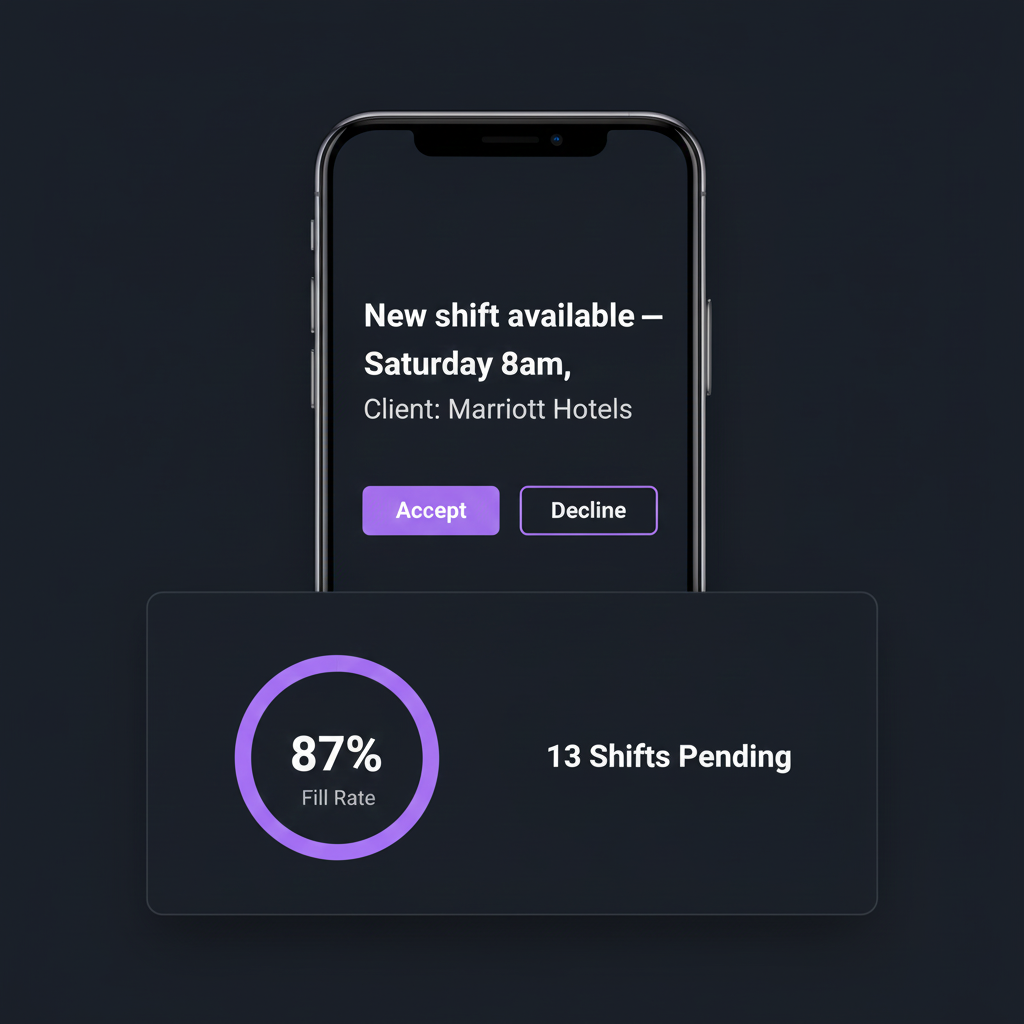
Search for "shift scheduling software" and the results are dominated by restaurant and retail tools. 7shifts, Deputy, HotSchedules, Homebase — all excellent products for businesses that schedule their own permanent or part-time employees. None of them are built for the staffing agency model, where the scheduler is not managing their own team but placing contingent workers into external client businesses, often at short notice and across multiple concurrent locations.
The difference is not cosmetic. It changes the fundamental mechanics of how scheduling software needs to work.
What Is the Core Difference Between Employer Scheduling and Agency Scheduling?
When an employer schedules their own staff, the pool of available workers is fixed and known. A manager opens a rota, assigns names to slots, and publishes it. Workers may swap shifts, but the pool does not change materially week to week. The scheduling problem is one of optimisation within a stable set of constraints.
When a staffing agency schedules workers for clients, the pool is dynamic, the workers may have no guaranteed hours, and fill rate — the percentage of requested shifts successfully covered — is the operational metric that determines agency viability. A shift that goes unfilled is revenue lost and a client relationship at risk. The scheduling software must support a fundamentally different flow.
What Does Shift Broadcasting Mean and Why Does It Matter?
Shift broadcasting is the mechanism by which a staffing agency publishes an open shift to a pool of qualified workers and waits for the first available worker to claim it. This is the inverse of the employer scheduling model, where a manager assigns shifts to named individuals. Broadcasting allows agencies to fill shifts faster, because the system does the work of finding an available worker rather than requiring a manager to call or message workers individually.
Agencies using shift broadcasting fill open shifts 3x faster than those using manual assignment or phone-based coordination
How Should Contingent Workers Manage Their Own Availability?
In a temp staffing model, workers are not employed with fixed contracted hours. They set their own availability windows — the days and times they are willing to work — and the scheduling system uses that availability to determine who receives shift broadcast notifications. A worker who is unavailable should not receive notifications, and should not be penalised for not responding. This requires availability management functionality that most employer-oriented scheduling tools simply do not have.
Ubeya's worker app allows contingent workers to set availability at a granular level, receive shift offers as push notifications, accept or decline with a single tap, and receive reminders before their scheduled shift. The fill rate impact of a smooth worker mobile experience is significant — agencies that move from phone or SMS coordination to a dedicated worker app report material improvements in shift acceptance rates.
How Do Staffing Agencies Handle Last-Minute Cancellations?
Last-minute worker cancellations are a structural feature of contingent workforce operations, not an exception. A purpose-built scheduling platform handles this with automated rematch: when a worker cancels, the system immediately re-broadcasts the shift to the next qualified, available worker without requiring manual intervention. Agencies using manual rescheduling — calling workers down a list — face a significant operational burden that grows linearly with volume.
Automated rematch on cancellation reduces coordinator time per incident from 18 minutes (manual) to under 2 minutes
What Should Staffing Agencies Look for in Scheduling Software?
- Shift broadcasting to qualified worker pools, with accept/decline via mobile app
- Worker availability self-management and preference setting
- Automated rematch on last-minute cancellations
- Multi-client shift management from a single scheduler dashboard
- Geofenced or app-based clock-in to confirm attendance without client-side action
- Real-time fill rate reporting per client and per shift type
- Integration with timesheet and payroll output, eliminating manual reconciliation
Ubeya's scheduling engine is built for the fill-rate problem. See how shift broadcasting, worker availability management, and automated rematch work in practice.
.jpg)

