
Most workforce management software is built for businesses that employ their own staff. A restaurant uses scheduling software to roster its chefs and servers. A retailer uses it to manage its floor team. That model is straightforward, and there are dozens of tools that handle it well.
Staffing agencies operate differently. They do not have one workforce — they have dozens of worker pools, assigned across multiple client businesses, each with its own requirements, shift patterns, and reporting needs. Software built for the restaurant model does not map cleanly onto the agency model, and the gap creates real operational problems at scale.
What Makes Staffing Agency Software Different from General Scheduling Tools?
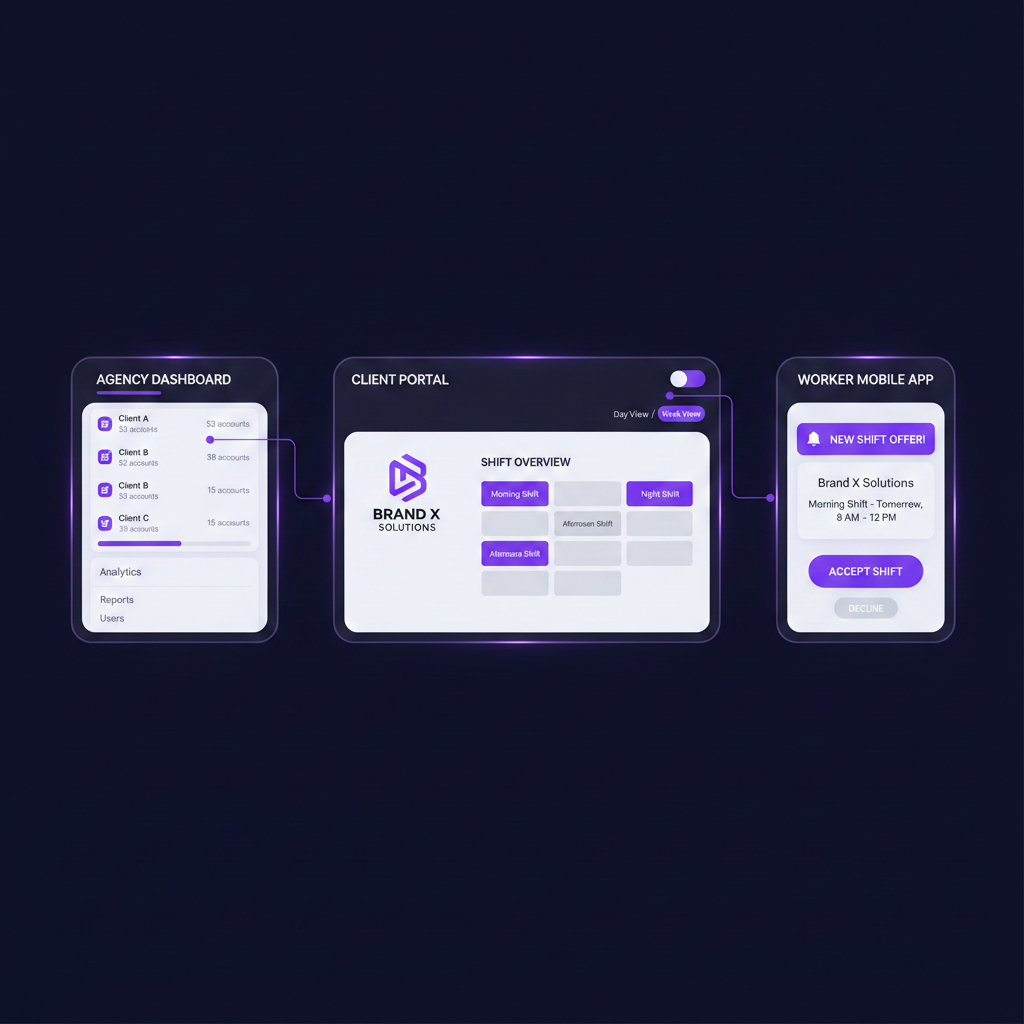
The defining characteristic of a staffing agency platform is the three-party relationship: the agency, the client businesses, and the workers. Software that handles this correctly needs to support:
- Multi-client management from a single dashboard. Agencies run shifts across multiple client accounts simultaneously. Logging into a separate system for each client is not operationally viable at scale.
- Transparent Data Access for Clients. Client businesses need seamless access to the data that matters to them — including shifts, workers, and billing — without relying on the agency’s internal systems. A branded, self-service portal that enables easy and secure data sharing with clients is a core operational requirement, not a premium add-on.
- Separate worker pools per client. Workers may be approved for some clients and not others based on skills, certifications, or client preferences. The system must enforce this at the assignment level.
- Worker-facing mobile apps. Contingent workers need to receive shift offers, confirm availability, clock in and out, and access their earnings — all from their phone, without friction.
Staffing agencies using purpose-built platforms report 40–60% reduction in scheduling admin time versus general scheduling tools - Deleware North cut admin time by over 80%
What Should Temp Agency Software Include in 2026?
The feature set that distinguishes purpose-built temp agency software from adapted general tools includes:
- Shift broadcasting and instant-fill. The ability to push open shifts to a qualified worker pool and fill them in minutes, not hours. Last-minute cancellations are routine in temp staffing — the system must handle them without manual effort.
- Geofenced clock-in. Workers confirm arrival at the correct location automatically, without relying on paper sign-in sheets or client-side confirmation.
- Multi-client billing and timesheets. Hours worked flow directly into client-specific timesheets and invoicing workflows, eliminating manual reconciliation between scheduling and payroll data.
- Compliance document management. Right-to-work checks, certifications, and visa status expiry alerts managed within the same platform as scheduling — not in a separate HR system that requires manual cross-referencing.
- Client-facing reporting. Agencies that give clients real-time visibility into shift coverage, attendance, and spend retain clients longer. This requires a reporting layer designed for external stakeholders, not just internal operations.
What Are the Most Common Mistakes When Choosing Temp Agency Software?
The most frequent mistake is selecting a tool based on scheduling features alone. Agencies that adopt general workforce platforms — even well-regarded ones — frequently find that the multi-client structure requires workarounds that become unmanageable as the agency grows. The second most common mistake is underestimating the worker experience. Workers who receive shift offers by text message or phone call — rather than through a clean mobile app — have lower fill rates and higher churn. The app experience directly affects the agency's ability to staff reliably.
What Verticals Benefit Most from Purpose-Built Staffing Software?
The use case for dedicated temp agency software is strongest in verticals where shift patterns are irregular, worker pools are large, and multi-site deployment is common. Event staffing, hospitality, and venue management are the clearest examples: agencies in these verticals routinely place 50–500 workers across multiple concurrent events, with different client briefs, check-in requirements, and shift lengths at each venue. Healthcare staffing and security services share similar structural characteristics.
Event and hospitality staffing agencies manage an average of 12 concurrent client accounts - each requiring separate shift logic, reporting, and billing
How Does Ubeya Approach the Staffing Agency Use Case?
Ubeya is built as a B2B2B platform: the agency is the primary user, client businesses are secondary users with their own branded portal access, and workers are the end users of the mobile app. This three-tier architecture means that each party sees only what is relevant to them, without the agency needing to manage separate accounts or data exports for each client relationship. Shift broadcasting, geofenced check-in, compliance document tracking, and client-facing reporting are all part of the core platform — not integrations with third-party tools.
See how Ubeya's staffing agency platform handles multi-client scheduling, worker management, and client portals in a single system.
.jpg)

