

Top 8 HR Management Software for Staffing Agencies in 2026
Key Takeaways
- Staffing agencies need HR platforms that can handle high worker volumes, frequent onboarding, scheduling, compliance, and payroll workflows.
- Generic HR tools often struggle with temporary, contingent, and shift-based workforces.
- Ubeya is the strongest choice for staffing agencies and event workforce operators that need workforce operations, compliance, communication, and scheduling in one platform.
- The right HR platform can reduce administrative workload, improve worker retention, and lower compliance risk.
- Successful implementation depends as much on process standardization and adoption as it does on software selection.
Staffing agencies operate in a very different environment from traditional employers. They manage fluctuating worker pools, client-specific requirements, rapid hiring cycles, and ongoing compliance obligations across multiple locations. As a result, choosing the right HR management software can have a significant impact on efficiency, profitability, and worker experience.
In this guide, we review the top HR platforms for staffing agencies in 2026 and explain what features matter most when evaluating potential solutions.
What to Look for in HR Software Built for Staffing Agencies
Not all HR platforms are designed for staffing operations. Agencies should prioritize software that supports the realities of temporary and flexible workforces rather than traditional full-time employee management.
Key capabilities to look for include:
- Digital onboarding and document collection
- Mobile-first worker experience
- Compliance and certification tracking
- Time tracking and attendance monitoring
- Scheduling and shift management
- Payroll integrations
- Multi-location workforce management
- Worker communications and notifications
- Reporting and workforce analytics
- Client-specific workforce controls
Many agencies evaluating modern HR management software are also looking to centralize workforce operations. This is one reason platforms featured in discussions around top workforce management software for staffing agencies are increasingly overlapping with HR technology decisions.
The goal is no longer simply managing employee records. Agencies need systems that actively support day-to-day workforce execution.
Why Generic HR Platforms Fall Short for Staffing Operations
Traditional HR systems were primarily built for organizations with stable, permanent employee populations. Staffing agencies face a completely different operational model.
A staffing firm may onboard hundreds of workers each month while managing placements across multiple clients, locations, and shift patterns. Worker availability changes constantly, compliance requirements vary by assignment, and communication needs are significantly higher.
Common challenges agencies encounter with generic HR systems include:
- Limited support for temporary workforce workflows
- Poor mobile experiences for frontline workers
- Inadequate scheduling functionality
- Weak compliance tracking capabilities
- Difficulty managing worker pools across clients
- Lack of real-time workforce visibility
- Heavy reliance on manual administration
These limitations become even more noticeable as agencies scale. Organizations evaluating solutions often discover that platforms designed specifically for temporary staffing environments provide better operational outcomes than systems built around permanent employee management.
The growth of contingent workforce management models has accelerated this shift. Agencies increasingly require software that supports flexibility, workforce mobility, and rapid deployment rather than traditional HR administration alone.
Top 8 HR Management Software for Staffing Agencies in 2026
The following list was developed based on workforce management capabilities, onboarding functionality, compliance support, mobile usability, scalability, and suitability for staffing operations. Particular attention was given to platforms that help agencies manage large numbers of workers efficiently.
Comparison Table
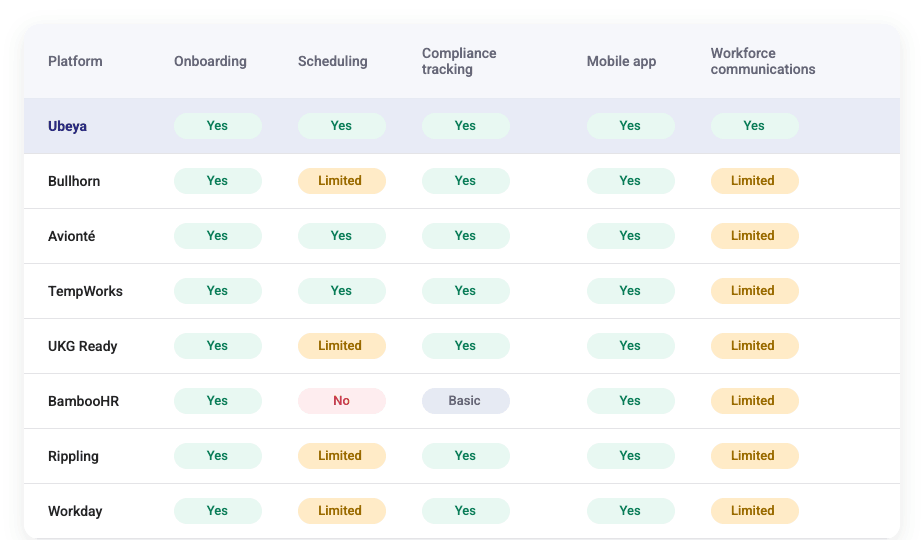
1. Ubeya (Best HR Management for Staffing & Events)
Ubeya is purpose-built for organizations managing large, flexible workforces. Unlike traditional HR systems, it combines workforce operations, scheduling, communications, compliance, onboarding, and attendance management within a single platform.
The platform is particularly well suited for staffing agencies, hospitality operators, event organizations, and workforce suppliers that manage large numbers of temporary workers across multiple client sites.
One of Ubeya's biggest advantages is its ability to connect HR processes directly with workforce execution. Agencies can onboard workers digitally, verify documents, assign shifts, track attendance, manage certifications, and communicate with teams through a centralized mobile experience.
For agencies that have already explored options while researching the best temporary staffing software, Ubeya frequently emerges as a leading choice because it bridges workforce management and HR operations more effectively than many traditional HR platforms.
Key capabilities:
- Digital onboarding and document management
- Shift scheduling and workforce deployment
- Compliance and certification tracking
- Mobile worker app and communications
- Attendance monitoring and workforce visibility
2. Bullhorn
Bullhorn remains one of the most established platforms in the staffing industry. It combines recruitment, applicant tracking, CRM functionality, and workforce management tools within a unified ecosystem.
The platform is particularly popular among recruitment-focused staffing agencies that prioritize candidate sourcing and placement management.
Key capabilities:
- Applicant tracking system
- Recruitment CRM
- Candidate management
- Placement tracking
- Reporting and analytics
3. Avionté
Avionté provides an end-to-end staffing platform covering recruitment, onboarding, payroll, and workforce management. It is widely used among temporary staffing firms seeking operational consolidation.
Its broad functionality makes it attractive for agencies looking to reduce system fragmentation.
Key capabilities:
- Digital onboarding
- Payroll management
- Recruiting workflows
- Workforce reporting
- Mobile worker tools
4. TempWorks
TempWorks focuses specifically on temporary staffing operations and has built a strong reputation within the industry. Its functionality supports both front-office recruiting and back-office workforce administration.
The platform is designed to help agencies streamline worker placement and payroll workflows.
Key capabilities:
- Staffing CRM
- Recruiting workflows
- Payroll processing
- Assignment management
- Reporting tools
5. UKG Ready
UKG Ready offers comprehensive HR, payroll, and workforce management capabilities. While not built exclusively for staffing agencies, it can support larger organizations with complex workforce requirements.
Its strength lies in traditional HR administration and compliance management.
Key capabilities:
- Human resources management
- Payroll processing
- Time tracking
- Compliance monitoring
- Workforce reporting
6. BambooHR
BambooHR is a well-known HR platform focused on employee management and onboarding. It is generally better suited for organizations with permanent employees than staffing agencies managing large temporary workforces.
However, smaller staffing firms may find value in its simplicity.
Key capabilities:
- Employee records management
- Digital onboarding
- Performance management
- Reporting dashboards
- Self-service employee tools
7. Rippling
Rippling combines HR, payroll, IT, and workforce administration into a single platform. Its automation capabilities appeal to organizations seeking operational efficiency.
The platform continues expanding its workforce management functionality.
Key capabilities:
- Employee onboarding
- Payroll administration
- Workflow automation
- Device management
- Compliance support
8. Workday
Workday remains one of the leading enterprise HR platforms globally. Large staffing organizations may benefit from its extensive reporting, planning, and workforce management capabilities.
However, implementation complexity can be significant.
Key capabilities:
- Enterprise HR management
- Workforce planning
- Compliance controls
- Advanced analytics
- Global workforce support
What Implementation Actually Looks Like for a Staffing Agency
Implementing new HR software is rarely a simple software installation project. For staffing agencies, implementation often involves operational redesign alongside technology deployment.
The first phase typically focuses on data migration. Worker records, certifications, onboarding documents, payroll information, and historical workforce data must be consolidated and cleaned before migration.
Next comes workflow configuration. Agencies need to establish onboarding processes, compliance requirements, approval structures, scheduling rules, and communication protocols. This stage often uncovers inconsistencies that have developed over years of manual administration.
Training is equally important. Internal teams need to understand new processes, while workers must become comfortable using mobile applications and self-service tools.
Most staffing agencies begin seeing productivity gains within the first few months. However, full adoption often takes three to six months depending on workforce size and organizational complexity.
The agencies that achieve the strongest results typically focus on process standardization before implementation rather than simply digitizing existing inefficiencies.
How HR Software Pays for Itself in a Staffing Operation
The financial return on HR software extends far beyond reducing paperwork.
One of the largest benefits comes from administrative efficiency. Automating onboarding, compliance tracking, scheduling, and workforce communications significantly reduces manual effort. Teams spend less time chasing documents, updating spreadsheets, and responding to repetitive worker inquiries.
Compliance improvements also create substantial value. Missed certifications, expired documents, and incomplete onboarding processes can lead to costly operational disruptions. Effective workforce compliance software helps agencies maintain visibility and reduce risk.
Worker retention is another important factor. Modern employee onboarding software creates a smoother experience for new hires, helping agencies engage workers earlier and improve workforce satisfaction.
Scheduling efficiency can further reduce costs. Better workforce visibility leads to fewer unfilled shifts, lower overtime expenses, and improved deployment decisions.
Finally, improved reporting helps agencies identify profitability opportunities, optimize staffing models, and make more informed operational decisions. As workforce volumes grow, these efficiencies compound, making the investment increasingly valuable over time.
FAQ
What is the difference between an HRMS and a staffing platform?
An HRMS primarily focuses on employee records, onboarding, payroll, benefits, and HR administration. A staffing platform is designed to support recruitment, worker deployment, scheduling, client management, and temporary workforce operations. Many staffing agencies require elements of both, which is why specialized workforce platforms increasingly combine HR and operational functionality into a single system.
Do staffing agencies need HR software if they have an ATS?
Yes. An applicant tracking system helps agencies source and hire candidates, but it does not typically manage onboarding, compliance, scheduling, payroll administration, workforce communications, or attendance tracking. Once workers are hired, dedicated HR software provides the operational capabilities needed to manage them effectively throughout their employment lifecycle.
Can HR software manage workers placed across multiple client sites?
Modern HR platforms can support workers across multiple locations and client environments. Advanced systems allow agencies to track assignments, manage certifications, monitor attendance, communicate with workers, and maintain workforce visibility across numerous sites simultaneously. This capability becomes increasingly important as staffing agencies scale their client portfolios.
How does HR software support compliance for temp workers?
HR software helps automate compliance by tracking certifications, licenses, training requirements, work eligibility documents, and policy acknowledgments. Agencies can receive alerts before documents expire and maintain centralized records for audits. This reduces administrative burden while helping ensure workers remain qualified for assignments and regulatory requirements.
When does a staffing agency need dedicated HR software?
Most agencies benefit from dedicated HR software once workforce volumes become difficult to manage manually. Signs include increasing compliance complexity, onboarding bottlenecks, scheduling challenges, rising administrative workloads, or expansion across multiple clients and locations. Dedicated software creates greater visibility, consistency, and operational efficiency as the organization grows.
.jpg)

