
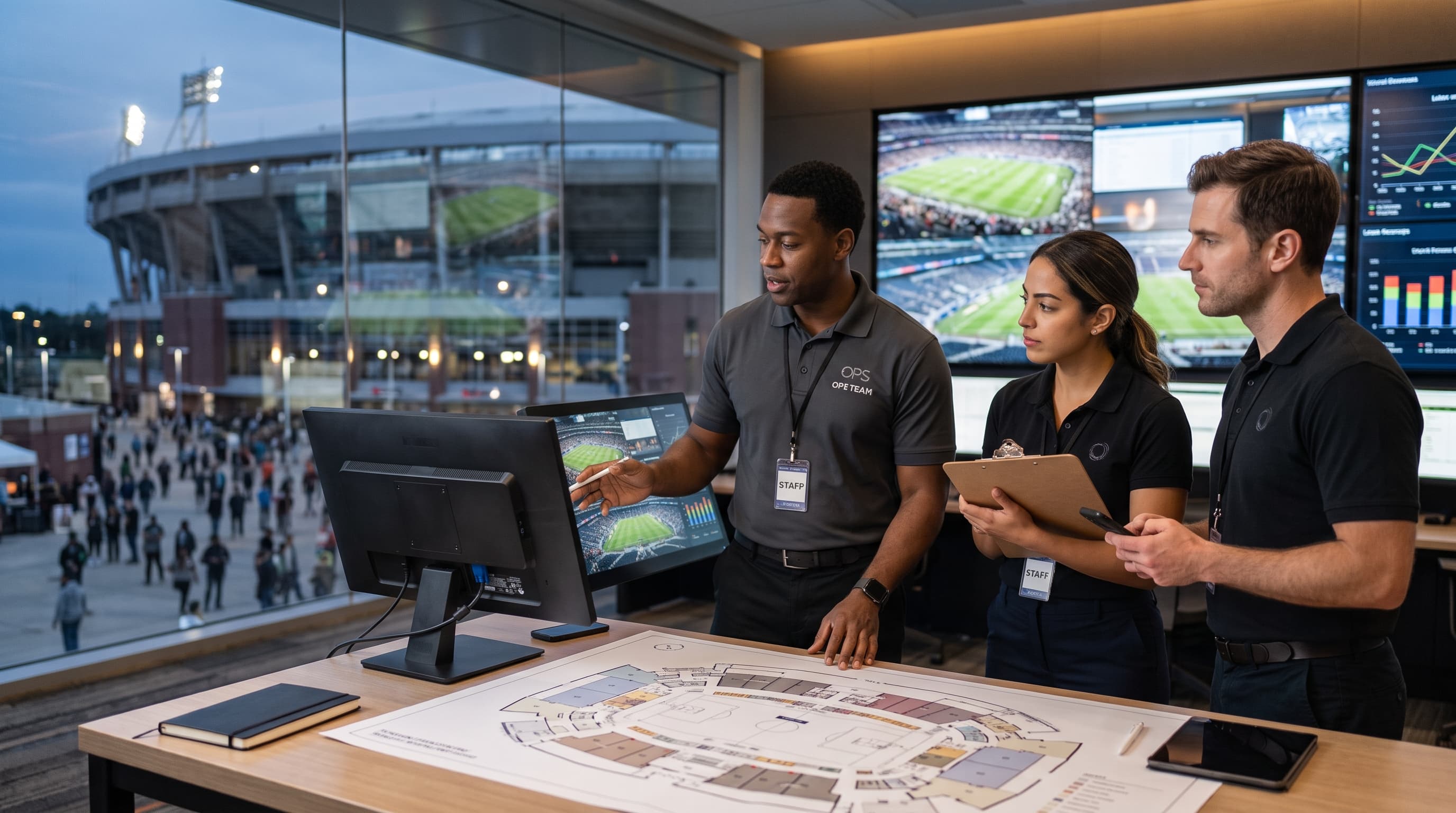
How to Calculate Stadiums Labor Cost And Keep It Under Control
Key Takeaways
- Labor represents the single largest variable expense in stadium operations, directly determining whether a major game day or concert turn a profit.
- Accurately measuring spend requires a comprehensive labor cost formula that accounts for gross hourly wages alongside payroll taxes, insurance premiums, and agency markup fees.
- Calculating labor cost percentage gives stadium operators a standardized metric to benchmark efficiency across diverse events, vendor groups, and venue zones.
- Deploying real-time labor cost tracking allows venue managers to make dynamic staffing adjustments during an active event before expenses exceed revenue targets.
Managing a major stadium or arena requires orchestrating hundreds—or even thousands—of hourly and temporary workers across security, concessions, ticketing, staging, and guest services. When gates open, labor spend begins accumulating rapidly. If guest attendance drops or food service sales slow down mid-event, fixed hourly staffing levels quickly erode profit margins.
Learning how to calculate labor cost accurately and monitor it in real time gives stadium executives the visibility needed to control costs, optimize shift dispatching, and protect overall venue profitability.
Why Labor Cost Is the Metric That Determines Profitability at Stadiums
In stadium management, fixed expenses such as venue financing, facility utilities, and baseline maintenance remain relatively stable month over month. Labor, by contrast, is highly variable. A single multi-day event can demand hundreds of thousands of dollars in wage payouts depending on event duration, guest turnout, and specialized role requirements.
Because staffing is the largest controllable expense on game day, even minor inefficiencies create massive financial leakages. Overstaffing an inactive concession concourse during a low-attendance event inflates operational budgets instantly. Conversely, understaffing leads to long lines, missed concessions sales, guest dissatisfaction, and overworked crews who incur costly overtime pay.
Because labor costs directly correlate with operational efficiency, mastering labor expense calculations is essential for venue directors seeking to maximize profit margins on every show.
The Labor Cost Formula and How to Apply It to a Stadium Operation
To calculate labor cost correctly, operators must look beyond base hourly wages. True labor cost—often referred to as the fully burdened labor cost—includes all direct and indirect expenses required to deploy a workforce onto the venue floor.
The Basic Labor Cost Formula
The baseline formula for determining total labor spend over a specific event or pay period is:
Total Labor Cost = Direct Wages + Payroll Taxes + Mandatory Benefits + Agency Fees & Markups + Overhead Allocation
Step-by-Step Application for a Stadium Shift
- Calculate Direct Wages: Multiply the total hours worked across all roles by their respective base hourly pay rates.
- Add Payroll Taxes and Insurance: Factor in employer-paid taxes (such as FICA, FUTA, and state unemployment) along with workers' compensation insurance premiums (typically adding 10% to 20% above base wages).
- Include Third-Party Agency Markups: If temporary agency workers fill shift gaps, add the agency's billable markup percentage directly to their worked hours.
- Add Administrative and Onboarding Expenses: Include uniform provisioning, credential badging, and digital system licensing allocated per worker.
For example, if a stadium deploys 100 concession workers for a 6-hour event at a base rate of $18/hour, direct wages equal $10,800. Adding 15% for payroll taxes and insurance ($1,620) plus $2,000 in agency markups yields a true fully burdened labor cost of $14,420 for that single department shift.
How to Calculate Labor Cost Percentage and What the Right Benchmark Looks Like
While total dollar spend shows total outlay, calculating your labor cost percentage reveals how efficiently labor generates venue revenue.
The Labor Cost Percentage Formula
To calculate labor cost percentage for an event or sales period:
Labor Cost Percentage = (Total Labor Cost / Total Gross Revenue) x 100
For example, if a stadium food service department incurs $30,000 in fully burdened labor costs during an event that generates $100,000 in gross concessions revenue:
Labor Cost Percentage = ($30,000 / $100,000) x 100 = 30%
Industry Benchmarks for Stadium Operations
Target benchmarks vary significantly across distinct venue departments:
- Food & Beverage / Concessions: Generally targets between 25% and 35% of gross food and beverage sales.
- Guest Services & Ticketing: Measured as a percentage of total ticket revenues or overall event operational budgets, typically targeting 8% to 12%.
- Operations, Security & Staging: Usually budgeted as a fixed operational cost per attendee or floor zone rather than a direct sales percentage, holding between 10% and 15% of total venue operational revenue.
Overall, major stadiums aim for an aggregated labor cost percentage between 20% and 30% of total gross event revenue.
The Hidden Labor Costs Most Stadium Operators Undercount
Failing to account for hidden labor expenditures leads to severe budget overruns at the end of a season. The most common unmeasured costs include:
- Unmonitored Overtime Accumulation: When events run long or delay cleanup, hourly workers quickly cross daily or weekly overtime thresholds, triggering 1.5x wage spikes that were not factored into initial event budgets.
- Third-Party Agency Markups and Fees: Relying on last-minute agency staffing to fill shift vacancies introduces bill rates that can be 30% to 50% higher than internal hourly wages.
- Pre-Shift and Post-Shift Paid Off-the-Clock Time: Mandated pre-shift security checks, uniform distribution, safety briefings, and post-event inventory reconciliations add non-revenue-generating paid hours to every shift.
- Onboarding and Credentialing Friction: Sourcing, background-checking, and badging high-turnover temporary workers creates massive administrative overhead that is rarely attributed directly to event labor budgets.
How to Use Real-Time Labor Tracking to Make In-Event Cost Decisions
Historically, stadium managers calculated labor spend days after an event ended when timesheets were reconciled for payroll. By then, unbudgeted labor overruns had already occurred.
Modern platforms change this dynamic through live labor cost tracking. Connecting mobile time clock apps with real-time POS sales feeds allows venue directors to monitor live labor cost percentages on a visual dashboard while the event is active.
If concessions sales peak during pre-game hours but drop dramatically by the third quarter, managers can identify overstaffed concourses instantly. Using real-time visibility, managers can release non-essential staff early, reassign workers to busy venue zones, or cut standby coverage. Deploying the best temporary workforce management software stadiums rely on allows operators to automate these real-time adjustments. Furthermore, combining location tracking with the best workforce management software for food services teams in 2026 ensures catering and concessions operations stay profitable throughout the event.
FAQs
How often should stadium operators review their labor cost data?
Stadium operators should monitor labor cost data at three distinct intervals: real-time during live events to manage active shift cuts, post-event within 24 hours to reconcile actual vs. budgeted spend, and monthly to analyze department trends, overtime patterns, and agency vendor markups.
Does overtime always indicate poor scheduling at stadium events?
Not necessarily. While unmanaged overtime signals scheduling flaws, planned overtime can be more cost-effective during short, high-demand event windows than onboarding, uniforming, and credentialing additional temporary workers who require baseline shift guarantees.
How do agency markup costs affect total stadium labor spend?
Agency markups significantly increase total labor spend because third-party providers add a 30% to 50% fee above base wages to cover their administrative overhead and profit. Uncontrolled reliance on agency labor quickly inflates overall venue labor cost percentages.
Can labor cost tracking work across multiple stadium departments?
Yes. Modern workforce software tracks time, pay rates, and billing rules by department, location, and role. This allows operators to analyze labor cost percentages separately for concessions, security, parking, and guest services within a single unified dashboard.
How does no-show rate affect stadium labor cost calculations?
High no-show rates force managers to over-schedule baseline headcount or call in last-minute agency replacements at premium bill rates. Both scenarios inflate labor costs, making proactive worker confirmation tools essential for maintaining accurate cost projections.
.jpg)

