
Workforce management software is one of the most searched categories in the HR technology market. But almost all of the content written about it — and most of the platforms available — is designed for businesses that employ their own staff. For staffing agencies, this creates a persistent gap: the tools that dominate WFM search results are not built for the operating model that agencies actually run.
This guide sets out what workforce management for staffing agencies needs to do, where employer-focused platforms fall short, and what to look for when evaluating purpose-built options.
What Is Different About the Staffing Agency Operating Model?
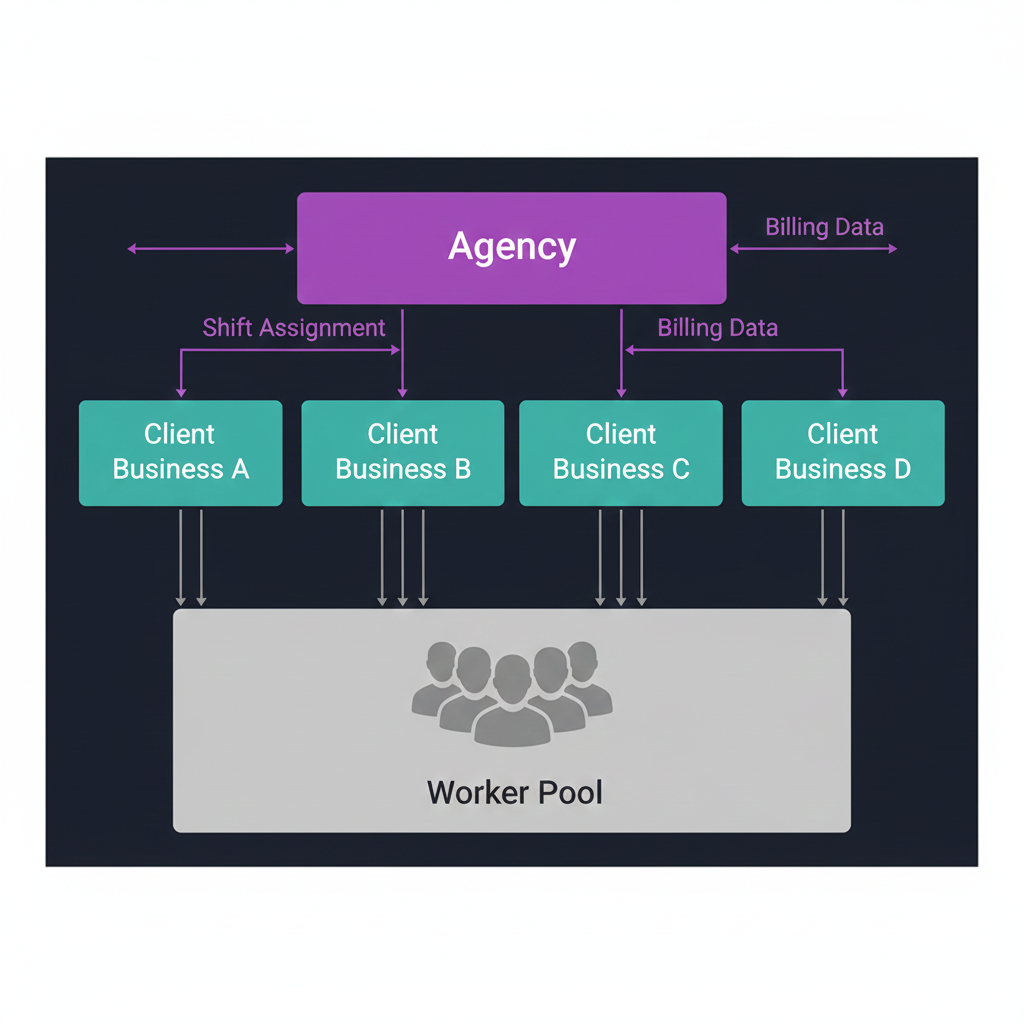
A staffing agency's operational complexity is multiplicative, not linear. A company with 200 employees manages one scheduling environment, one payroll, and one compliance framework. A staffing agency with 200 active workers may be placing them across 30 different client businesses, each with different shift requirements, billing rates, and reporting expectations. The WFM system must handle this multiplicity at the structural level.
Three elements of the agency operating model require specific platform support that general WFM tools rarely provide:
- Multi-client management. All client accounts visible and manageable from a single agency dashboard, with client-specific settings for billing rates, worker approvals, and shift types.
- Worker pool segmentation. Workers assigned to specific clients based on skills, certifications, client preference, or contractual approval — enforced at the system level, not managed manually by coordinators.
- Separate billing per client. Hours worked per client generate client-specific timesheet outputs and billing records, not a single consolidated payroll run.
How Does a Staffing Agency Platform Handle Client Billing?
Billing in a staffing agency context is more complex than payroll. The agency pays the worker at one rate and invoices the client at another — the margin between these two figures is the agency's commercial return per shift. A purpose-built WFM platform tracks both rates, calculates margin per shift and per client, and generates separate invoice-ready output for each client without manual spreadsheet reconciliation.
Agencies that manage this process in spreadsheets alongside a general scheduling tool consistently report that billing reconciliation consumes more coordinator time than shift management itself. The operational efficiency case for an integrated billing layer is strong.
Agencies using integrated scheduling and billing report 65% reduction in end-of-month reconciliation timeSource: Ubeya customer data, 2025
What Role Does the Client Portal Play in Agency WFM?
Client retention in temp staffing is driven in large part by client experience. Clients who can see their own shift coverage in real time, submit new shift requests directly through a portal, and access their own timesheet and billing records without emailing the agency are more likely to expand their relationship with that agency. A white-label client portal — branded to the agency, not the software vendor — gives the agency a professional interface that reinforces its own brand identity with each client interaction.
What Compliance Functions Must Agency WFM Include?
Staffing agencies carry compliance responsibilities that direct-hire employers do not. Right-to-work verification, certification expiry tracking (food hygiene, first aid, SIA licences), and IR35 or employment status documentation are all agency responsibilities that affect which workers can legally be deployed to which clients. A WFM platform that does not surface these compliance dependencies at the point of scheduling is creating risk, not reducing it.
Ubeya's compliance module tracks document expiry dates, blocks scheduling of workers with expired certifications, and sends automated renewal reminders — removing the compliance checking burden from individual coordinators.
Purpose-built staffing platforms with integrated compliance tracking reduce compliance-related scheduling errors by over 80%Source: Ubeya internal data, 2025
Ubeya is built for the staffing agency operating model — multi-client scheduling, worker pools, client portals, integrated billing, and compliance tracking in a single platform.
.jpg)

