
Discover eight leading temp recruitment software platforms for high-volume staffing agencies, comparing features, pricing, and capabilities. Learn how the right software can streamline recruitment, automate onboarding, simplify shift scheduling, and connect time tracking with payroll.
8 Best Temp Recruitment Software Platforms for High-Volume Staffing Agencies
Key Takeaways
- High-volume temporary staffing requires dedicated temp recruitment software that unites rapid applicant sourcing, automated credential vetting, and immediate worker dispatch into a continuous operational pipeline.
- Standard direct-hire applicant tracking systems break down in contingent staffing because they are designed for linear multi-interview cycles rather than re-deployable talent pools and hourly shift placements.
- Essential platform features include dual-sided staffing ATS and staffing CRM functionality, automated license and compliance tracking, multichannel candidate messaging, and integrated time-to-payroll workflows.
- Ubeya provides an end-to-end platform connecting high-volume talent sourcing and mobile onboarding directly with live scheduling, geofenced time tracking, and automated payroll preparation.
Operating a high-volume staffing agency means managing a fast-moving, continuous cycle of worker demand and candidate availability. When clients submit orders for dozens of event staff, warehouse operatives, or hospitality workers on tight turnarounds, traditional recruitment workflows collapse under administrative weight. Relying on disconnected spreadsheets, generic job boards, and manual messaging creates severe placement bottlenecks, credential oversights, and lost client revenue.
Adopting modern temp recruitment software transforms how agencies operate, allowing recruitment desks to source, qualify, and place hundreds of hourly workers in minutes while protecting margins and client satisfaction.
Temp Recruitment Software and High-Volume Hiring
Temp recruitment software is built specifically for the operational velocity of contingent staffing agencies, where placements are measured in hours and shifts rather than weeks or months. Unlike traditional corporate recruiting software built to evaluate individual candidates for permanent vacancies, high-volume recruiting software focuses on building, maintaining, and instantly activating large pools of pre-vetted, flexible labor.
In high-volume temporary hiring, an agency's success depends on cycle time and fill rates. Recruitment teams must source hundreds of applicants per week, verify right-to-work documentation and role certifications, group workers into searchable talent pools, and match availability against active client work orders.
Once placed, a temporary worker's journey does not end; they must be tracked on site, paid accurately for worked hours, billed to clients at specific margin rates, and re-deployed to new shifts. Purpose-built staffing agency software supports this entire lifecycle, converting candidate relationship management directly into operational deployment without fragmented data handoffs.
Staffing ATS, CRM and Candidate Sourcing Features to Look For
Selecting the right platform for high-volume staffing requires evaluating capabilities across three core operational pillars:
Sourcing and Candidate Intake
- Multichannel Candidate Sourcing: Native candidate sourcing software integrations with job aggregators, social platforms, programmatic job boards, and branded career pages allow agencies to capture applicants at scale.
- Frictionless Mobile Onboarding: Temporary workers prioritize speed. Platforms should allow applicants to complete registration forms, sign digital contracts, and upload credentials from their smartphones without downloading complex software.
- Automated Parsing and Profile Enrichment: Resumes, certifications, and identification documents should parse instantly into standardized candidate profiles.
Staffing ATS Capabilities
- Automated Credential and Compliance Verification: The system must track document expiration dates, right-to-work statuses, and safety certifications, systemically blocking unverified workers from placement.
- Dynamic Talent Pool Tagging: Group candidates by skills, location proximity, uniform sizing, verified experience, and performance ratings for instant segment filtering.
- AI-Assisted Candidate Matching: Algorithmic matching scores existing pool candidates against incoming client orders to surface qualified, available workers in seconds.
Staffing CRM and Operational Deployment
- Unified Client Pipeline and Order Management: A dedicated staffing CRM tracks open client orders, bill rates, specialized shift requirements, and client-specific onboarding protocols within a single dashboard.
- Omnichannel Messaging Tools: Built-in SMS, WhatsApp, and in-app push notifications enable recruiters to broadcast open shifts to hundreds of qualified workers simultaneously.
- Integrated Time and Pay-Bill Architecture: The system must bridge placements directly into attendance tracking, timesheet approvals, and client invoicing to eliminate payroll reconciliation disputes.
8 Best Temp Recruitment Software Platforms
We evaluated the top eight temp recruitment and high-volume staffing platforms designed to streamline candidate intake, placement operations, and client management.
1. Ubeya
- Best For: High-volume staffing agencies, event staffing firms, hospitality providers, and logistics operations needing seamless talent sourcing, mobile onboarding, smart dispatch, and pay-bill integration.
Ubeya is an all-in-one workforce management and temp recruitment platform engineered specifically for high-velocity, shift-based staffing operations. Rather than forcing agencies to string together separate sourcing apps, applicant tracking tools, and dispatch spreadsheets, Ubeya connects candidate acquisition directly with real-time operational deployment.
The platform provides customizable digital registration flows where candidates submit documents, verify right-to-work status, and complete onboarding on their mobile phones. Once approved, candidates instantly become part of an active, searchable talent pool. Recruiters can broadcast open shifts to pre-qualified workers via a native mobile worker app, where staff claim shifts, view venue briefs, clock in via GPS geofencing, and track their pay. Ubeya's automated compliance engine verifies licenses before allowing shift confirmations, while its integrated back office calculates complex multi-rate timesheets and generates clean payroll and invoicing data.
For agencies seeking deeper strategic visibility, reviewing our temp agency software guide 2026 highlights how end-to-end automation protects operating margins. Additionally, learning how AI's impact on recruiting revolutionizes candidate screening demonstrates how Ubeya shortens time-to-fill across high-volume roles.
- Pricing: Custom quote based on active worker volume and organizational scale; includes full platform access with worker and client mobile apps.
2. Bullhorn
Bullhorn is a widely recognized enterprise staffing ATS and CRM platform serving large recruitment agencies across contract, contingent, and permanent sectors. It provides extensive candidate relationship management, email automation sequences, and deep third-party integrations via the Bullhorn Marketplace. The platform manages candidate intake, placement tracking, and back-office invoicing workflows effectively for high-volume enterprise firms. However, its complex interface, extensive implementation cycles, and modular add-on pricing make it less agile for fast-moving, shift-based gig agencies needing turn-key mobile dispatch.
- Best Fit: Large enterprise staffing agencies with dedicated IT administrators managing complex VMS integrations.
- Pricing: Tiered enterprise pricing available by quote; typically starts around $99 to $165+ per user per month, with add-on modules for advanced automation and back-office tools.
3. Recruit CRM
Recruit CRM is an accessible cloud-based recruitment platform that combines an applicant tracking system with a sales CRM in an intuitive interface. It allows recruitment teams to manage candidate pipelines, log client communication, parse resumes, and post open jobs to major job boards. The platform includes integrated calling and email sequencing tools, making it easy for recruiters to engage active candidate databases. While it supports contract placements well, agencies managing fast-paced hourly shift dispatching and GPS time tracking will require separate workforce management tools.
- Best Fit: Small-to-midsize recruitment agencies seeking a clean, combined ATS and CRM for contract and perm placements.
- Pricing: Tiered per-user subscriptions starting at approximately $85 per user per month, scaling up for enterprise features.
4. Manatal
Manatal is an AI-powered cloud recruitment platform that simplifies candidate sourcing and applicant tracking for staffing firms and corporate talent teams. It offers profile enrichment tools that pull public data from social profiles, automated resume scoring, and social media job sharing. Its visual kanban pipelines allow recruiters to track candidate progress across various client requisitions smoothly. While highly cost-effective for candidate sourcing and candidate intake, it lacks dedicated hourly shift scheduling and geofenced timekeeping features.
- Best Fit: Growing recruitment agencies focused on cost-effective candidate sourcing, pipeline tracking, and resume parsing.
- Pricing: Transparent per-user pricing starting from $15 to $35 per user per month.
5. Tracker
Tracker is an integrated recruitment ATS and CRM software suite designed specifically for staffing and recruitment agencies. It consolidates sales lead tracking, candidate relationship management, digital onboarding, and placement records into a single platform. Tracker offers customizable candidate portals, integrated video interviewing, and automated email marketing cadences. The platform handles contract placement documentation cleanly, though agencies managing same-day hourly shift rosters often pair it with mobile dispatch software.
- Best Fit: Mid-market staffing agencies managing blended business models of contract, temp-to-hire, and direct-hire placements.
- Pricing: Custom pricing based on user tiers and feature requirements, available upon request.
6. Recruiterflow
Recruiterflow is a modern recruiting CRM and applicant tracking system built heavily around workflow automation and candidate nurture cadences. It provides recruitment agencies with visual candidate pipelines, two-way email synchronization, and automated multi-step outreach sequences. Recruiters can automate status triggers, client update emails, and interview reminders effortlessly. While exceptionally strong at candidate engagement and business development workflows, it is not engineered for high-density hourly shift allocation or field-based time clock capture.
- Best Fit: Tech-forward recruiting agencies prioritizing outbound candidate sourcing and automated multi-channel follow-ups.
- Pricing: Subscription plans start at approximately $119 per user per month when billed annually.
7. Vincere
Vincere, part of The Access Group, is an enterprise-oriented recruitment operations platform designed specifically for staffing and executive search firms. It offers specialized modules for candidate recruitment, client CRM, temp shift scheduling, and financial pay-bill processing. Vincere provides deep operational reporting, KPI tracking dashboards, and multi-currency billing support. Because of its broad feature catalog and modular design, implementation and user training can require substantial time and resources.
- Best Fit: Established, multi-desk staffing agencies running high-volume temporary and contract divisions across multiple branches.
- Pricing: Custom quote-based pricing structured around user volume and required functional modules.
8. Loxo
Loxo is an AI-driven talent intelligence platform that functions as an applicant tracking system, sourcing engine, and candidate CRM. It features a proprietary database of millions of candidate profiles, enabling recruiters to source and verify contact information directly within the tool. Loxo automates multichannel outreach campaigns across email and SMS, helping recruiters engage talent rapidly. While outstanding for candidate sourcing and executive search pipelines, it does not support frontline shift management, geofenced clock-ins, or dynamic venue rosters.
- Best Fit: Executive search, direct-hire, and professional contract staffing firms looking for advanced candidate sourcing and outreach intelligence.
- Pricing: Offers a basic tier alongside paid plans typically ranging from $109 to $169+ per user per month.
Comparing Temp Recruitment Platforms Side by Side
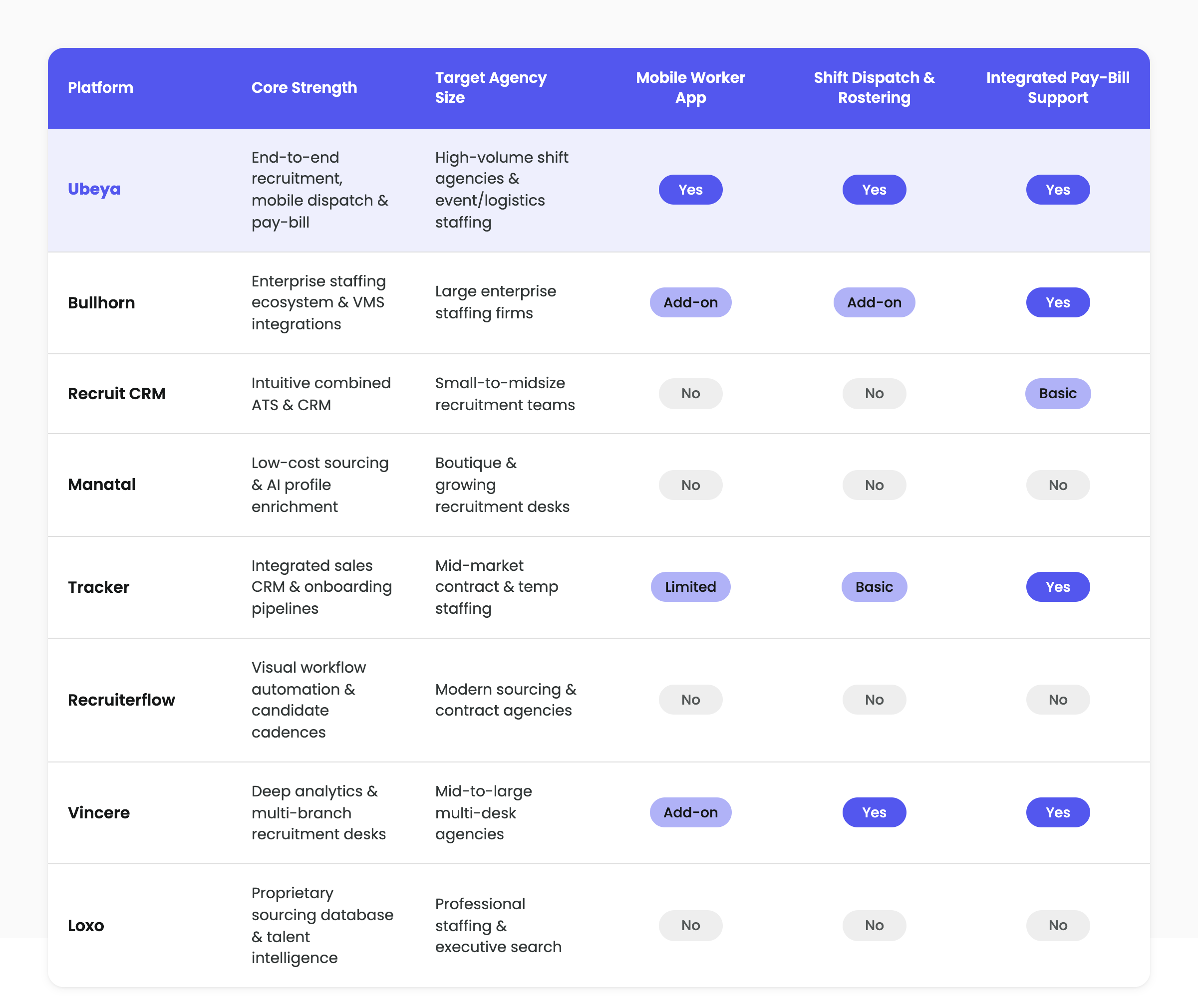
The primary distinction between platforms lies in their operational scope. Tools like Loxo, Recruiterflow, and Manatal excel at front-end talent sourcing, resume parsing, and relationship nurturing, making them ideal for agencies that hand candidates off to clients. Platforms like Bullhorn provide deep enterprise infrastructure but often treat mobile candidate interactions as an add-on layer. In contrast, Ubeya unifies front-end candidate onboarding directly with live shift dispatching and time-tracking, making it the most practical architecture for agencies managing dynamic hourly workforces.
Matching a Platform to Your Agency’s Placement Volume
Choosing the right software requires evaluating your agency's operational model, placement frequency, and technical requirements:
Boutique Agencies Placing Contract Roles
If your firm primarily places technical, creative, or executive contractors for multi-month assignments, prioritize platforms with strong candidate relationship management, automated email sequencing, and resume parsing (such as Recruit CRM, Recruiterflow, or Manatal). In these operations, relationship nurturing matters more than real-time shift dispatch.
High-Volume Shift-Based Agencies
Agencies providing temporary staff for events, stadiums, hospitality, logistics, warehousing, or retail require platforms built for high-density hourly turnover. You need a system that supports mobile onboarding, automated license compliance, bulk shift broadcasting, and GPS-verified time tracking (such as Ubeya). Choosing a platform that lacks native mobile dispatch will force your recruiters to rely on manual messaging and separate spreadsheets.
Enterprise Multi-Branch Staffing Organizations
Large staffing corporations managing thousands of dispersed placements across multiple sectors and vendor management systems (VMS) require deep enterprise governance, complex billing structures, and custom API connections (such as Bullhorn or Vincere). These agencies need dedicated systems of record that support multi-entity financial ledgers alongside recruitment pipelines.