Explore six leading employee self-service tools for stadiums, events, and high-volume staffing teams, comparing their key features and capabilities. Discover how mobile self-service simplifies shift management, improves workforce communication, reduces admin, and streamlines attendance tracking and payroll.
Best 6 Employee Self-Service Tools for Event and Stadium Staffing Teams in 2026
Key Takeaways
- Employee self-service tools for event and stadium staffing must prioritize mobile-first shift claiming, real-time availability submission, and GPS time tracking over traditional corporate desk features.
- Seasonal and casual stadium crews require frictionless mobile logins without corporate email accounts or complex password setups.
- Implementing self-service automates schedule confirmations, reduces call-outs, and cuts administrative time spent coordinating shift coverage.
- Ubeya unites mobile employee self-service with intelligent venue scheduling, live attendance dashboards, and automated payroll preparation.
Operating stadiums, arenas, and large-scale live events requires coordinating massive numbers of temporary and hourly workers across security, concessions, ticketing, and guest services. When shift rosters involve hundreds or thousands of casual workers, managing availability through phone calls, paper forms, and fragmented messaging apps creates severe administrative bottlenecks.
Adopting a specialized employee self-service tool allows venue directors to empower temporary staff to manage their own schedules, confirm shifts, swap assignments, and track worked hours directly from their smartphones, ensuring venues stay fully staffed on game days.
What Employee Self Service Means for Event and Stadium Staffing Teams
In a traditional corporate office, an employee self-service portal typically handles annual benefits enrollment, formal performance reviews, paid time off accruals, and corporate expense reports. These features are designed for salaried employees who sit at computer workstations five days a week.
In high-volume event and stadium staffing, employee self service looks fundamentally different. Frontline venue staff are mobile, deskless, and often work on an intermittent or seasonal basis. For these workers, self-service is not about corporate HR administration; it is about real-time shift participation.
In an event staffing context, self-service means giving casual staff a native workforce app where they can view upcoming event calls, submit availability for specific match days, accept or decline open shift dispatches with a single tap, swap assignments with qualified peers, clock in via geofenced GPS, and access digital payslips. Instead of relying on dispatch coordinators to manually confirm every worker, the platform turns the worker's smartphone into an operational hub that syncs directly with central venue rosters.
The Specific Self Service Features That Matter Most for Temporary and Seasonal Workers
Because event crews change frequently and operate under fast-paced conditions, tools built for permanent desk workers cause friction. Temporary and seasonal crews need features specifically tailored to deskless shift dynamics:
- Passwordless Mobile Authentication: Seasonal workers forget logins between events. Tools that utilize SMS verification codes or mobile phone number logins eliminate access hurdles and ensure workers can review schedules instantly.
- Event-Specific Availability Submission: Instead of setting recurring weekly schedules, casual staff need the ability to submit availability for specific event dates and match days well in advance.
- Self-Service Shift Bidding and Claiming: When schedule vacancies arise, workers should be able to browse open shifts filtered by their role credentials, claiming available slots directly from their mobile workforce app.
- Peer-to-Peer Shift Swapping: Workers who experience last-minute conflicts need an intuitive mechanism to offer shifts to qualified peers, with built-in rules that verify qualifications and prevent overtime before routing to managers for approval.
- Geofenced Mobile Punch In and Punch Out: The app must allow workers to clock in and out using GPS location verification, confirming their physical presence inside venue gates without standing in long check-in lines.
- Instant Shift Briefings and Digital Document Access: Venue maps, gate access instructions, uniform requirements, and event run-of-show documents should sit right alongside the scheduled shift.
- Live Earnings and Digital Payslip Views: Workers want real-time visibility into their approved hours, expected earnings, and downloadable pay summaries directly within their mobile interface.
The 6 Best Employee Self Service Tools for Event and Stadium Staffing Teams in 2026
To help stadium and venue operators choose the right platform, we evaluated the top six employee self-service tools engineered for high-volume, event-based, and hourly staffing environments.
1. Ubeya
- Best For: Stadiums, arenas, high-volume event staffing agencies, hospitality groups, and security operations managing dynamic casual and contingent workforces.
Ubeya provides an all-in-one workforce management platform built explicitly for high-velocity, shift-based venue and event operations. Its native mobile workforce app delivers an intuitive self-service hub tailored to temporary and casual crews. Workers log in using simple SMS verification, eliminating password hurdles. Through the mobile interface, crew members submit availability for specific event dates, receive instant shift dispatches, browse and bid on open venue roles, and arrange manager-approved shift swaps with qualified peers.
On event day, workers view interactive venue maps, gate instructions, and uniform policies, then clock in via GPS geofencing or scan-in kiosks. The app also gives workers transparent access to digital timesheets and estimated earnings. For managers, these self-service actions feed directly into live operational dashboards, automating shift confirmations, tracking attendance in real time, and preparing accurate payroll. Pairing Ubeya's self-service tools with the best temporary staffing software ensures venue operators maintain control across internal staff and third-party partner agencies.
2. Connecteam
Connecteam offers a versatile mobile app designed for non-desk and field-based employees. Its self-service capabilities include mobile schedule views, shift bidding, peer-to-peer shift swaps, and GPS time tracking. The platform also provides hr self service tools, such as digital employee document storage, mobile onboarding workflows, and in-app training courses. While highly accessible for general deskless teams, enterprise stadium operators managing complex multi-tier vendor pools or dynamic client billing rates may require deeper agency-specific customization.
3. Deputy
Deputy is a widely used scheduling and workforce management tool built for retail, hospitality, and event businesses. Its mobile self-service app allows hourly workers to view their schedules, claim open shifts, swap shifts with team members, and request time off. Workers can clock in using GPS location validation on their mobile devices or through tablet kiosks featuring facial recognition. Deputy excels at enforcing meal break compliance and overtime alerts, though its structure is less tailored to managing multi-agency labor pools across large sports facilities.
4. 7shifts
7shifts is tailored specifically for the restaurant and hospitality sector, making it an excellent choice for stadium concessions, VIP catering suites, and venue dining teams. The platform's mobile app enables concession workers to submit availability, view upcoming catering schedules, trade shifts with certified peers, and chat with team leads. While exceptional for food and beverage staffing, it lacks specialized features for venue security, ticketing logistics, or technical staging crews.
5. When I Work
When I Work provides an accessible scheduling and attendance tracking app designed for hourly and small-to-midsize event teams. Its mobile self-service interface enables workers to set availability preferences, claim open shifts on a first-come basis, and request peer shift trades. Workers clock in through mobile GPS check-ins, while managers retain final approval over schedule changes. While simple to deploy and cost-effective, enterprise stadiums with multi-layered credential tiers may find its reporting capabilities basic.
6. Teambridge
Teambridge offers a customizable workforce management platform built for frontline and event operations. It allows managers to design custom mobile workflows, giving casual workers self-service tools to complete onboarding forms, upload credential documents, claim open shifts, and track hours. The platform features rule-based automation that matches worker qualifications to shift requirements automatically. While highly flexible, configuring custom self-service workflows requires initial setup time.
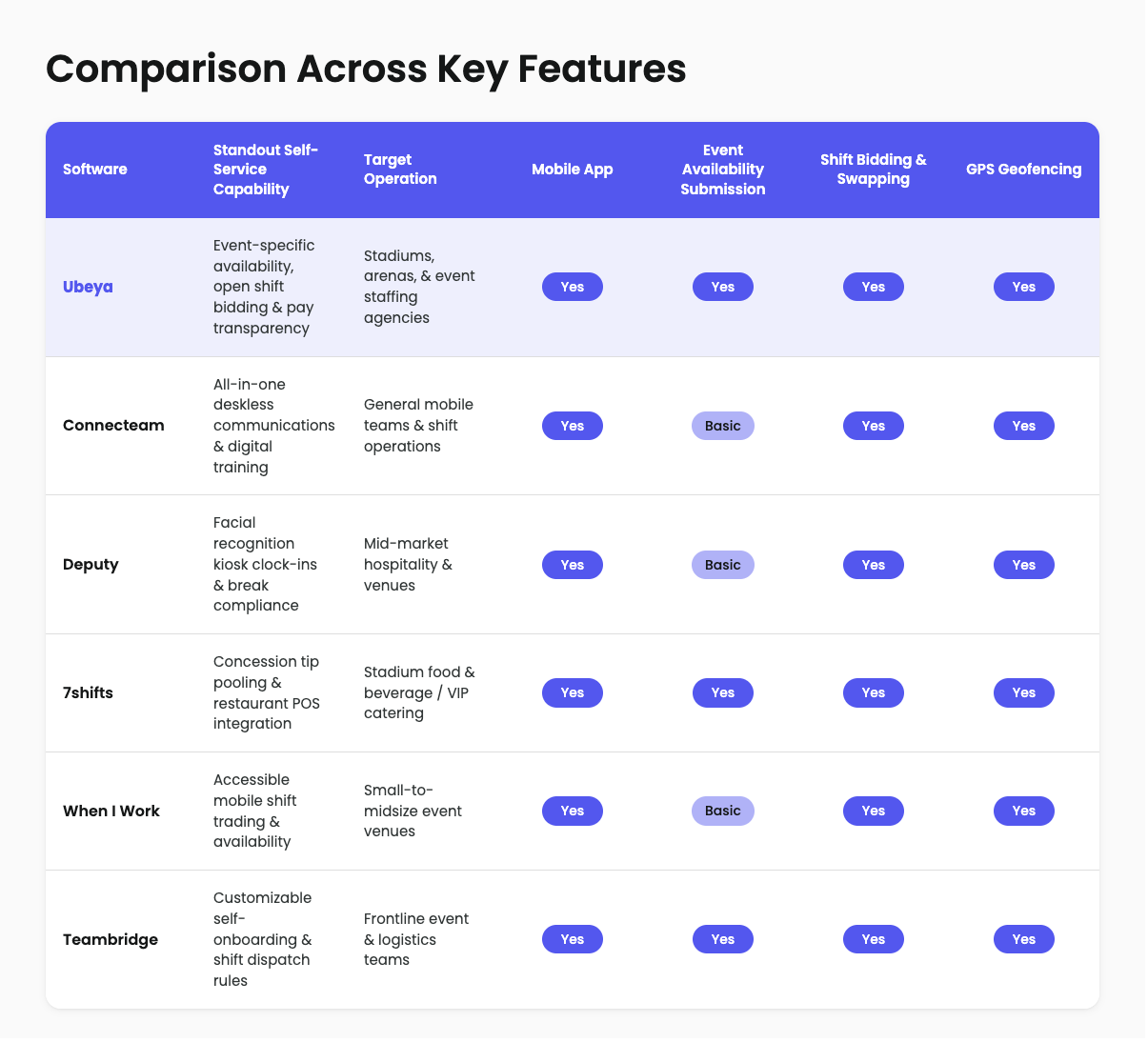
Comparison Across Key Features
Which Operation Type Gets the Most From Employee Self Service
While self-service creates efficiencies across various operational models, the return on investment varies significantly depending on workforce composition:
Large Stadiums and Multi-Day Festivals
Large sports arenas, convention centers, and multi-day festival productions experience the highest operational gains. Coordinating thousands of casual workers across distinct zones—such as ticketing, security, turnstiles, and concessions—makes manual communication impossible. Self-service tools automate shift confirmations, fill last-minute vacancies through mobile bidding, and eliminate physical check-in queues on event days. Exploring how stadiums leverage AI shift scheduling for venues illustrates how self-service availability feeds automated roster generation to optimize game-day staffing.
Event Staffing and Hospitality Agencies
Temporary staffing agencies supplying variable crews across multiple venues gain massive efficiency improvements. Self-service portals allow agencies to onboard candidates digitally, verify right-to-work documents remotely, and broadcast open client shifts to thousands of pre-qualified workers simultaneously without manual phone calls.
Small Fixed-Roster Operations
Venues with a small, permanent workforce working consistent, predictable hours see less immediate value from complex self-service features. When schedules rarely fluctuate and team members communicate daily on site, standard digital rosters often suffice without needing multi-tier shift bidding or dynamic availability management.
What Changes for Managers When Staff Handle Their Own Scheduling and Requests
Implementing employee self-service fundamentally transforms a venue manager's daily workflow, shifting their focus from manual coordination to strategic operational oversight:
- Elimination of Repetitive Messaging: Managers no longer spend hours answering calls, texts, and emails regarding shift start times, venue directions, uniform codes, or availability.
- Automated Shift Trade Verification: Instead of manually checking whether a replacement worker holds the required alcohol certification or if a swap triggers overtime pay, the platform evaluates compliance rules automatically before presenting the request for sign-off.
- Real-Time Attendance Monitoring: Rather than checking off names on paper clipboards at entry gates, managers monitor a live digital dashboard displaying real-time GPS clock-ins, instantly identifying unfilled posts before gates open.
- Proactive Incident Management: With routine scheduling tasks automated, supervisors can spend their time on the venue floor supporting staff, addressing guest service issues, and ensuring smooth event execution.
What Happens to Scheduling and Payroll Efficiency After Self Service Is in Place
The downstream impact of employee self-service extends across operational and finance departments, driving measurable performance improvements:
Drastic Drop in Shift Vacancies and No-Shows
When workers set their own availability and actively claim shifts through a mobile workforce app, commitment levels increase. Automated mobile push reminders and mandatory shift re-confirmations reduce no-show rates, ensuring venue posts remain fully staffed.
Accelerated Roster Finalization
Instead of building schedules through trial and error, schedulers generate rosters using pre-submitted worker availability. Dispatchers broadcast remaining open shifts to targeted talent pools, filling hundreds of positions in minutes rather than days.
Error-Free Digital Payroll Processing
Self-service mobile time clocks capture accurate punch data linked directly to scheduled roles and pre-set pay rates. The system flags exceptions, meal break violations, and overtime hours automatically for supervisor review. When pay periods close, verified digital timesheets export directly into payroll systems without manual spreadsheet data entry, eliminating payroll disputes and saving days of administrative work.